Bhai Bhag Singh Gurdwara in Kurri, Rawalpindi: History and Ruins
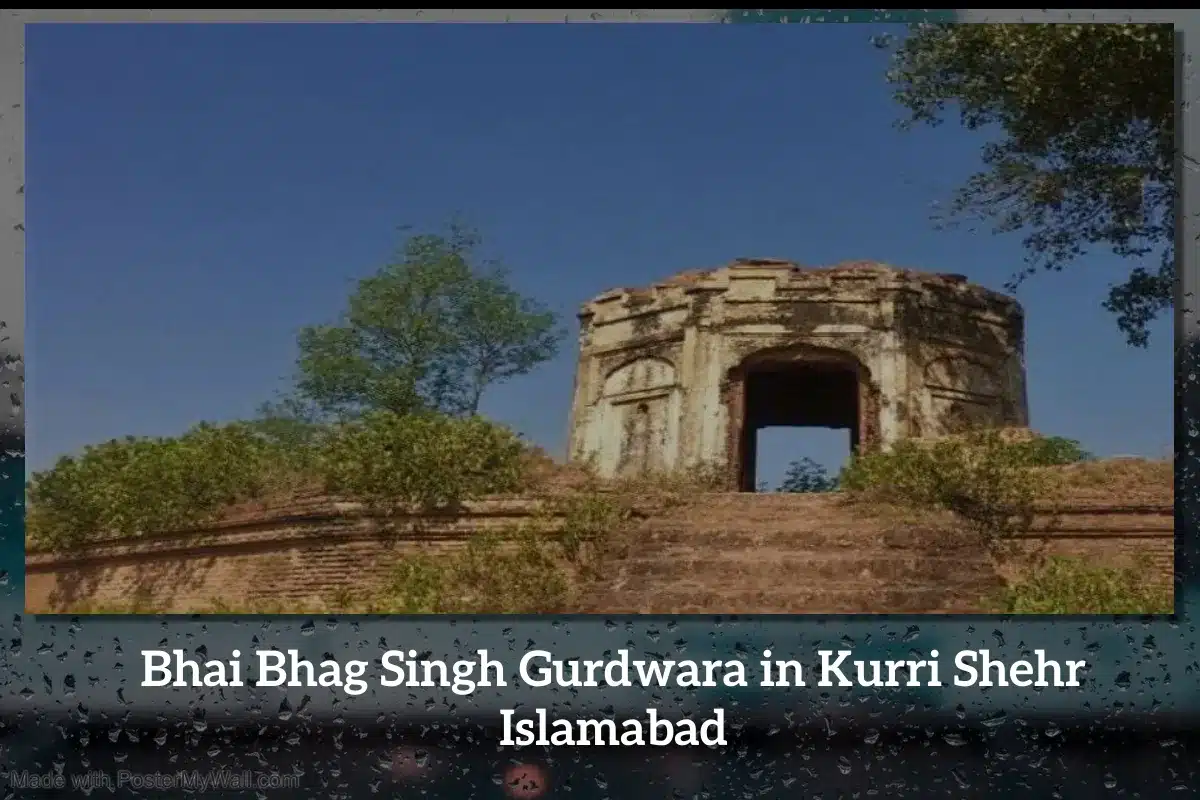
The ruins of Bhai Bhag Singh Gurdwara stand in Kurri, an old settlement near Islamabad and Rawalpindi. Although much of the religious complex has disappeared, its surviving baradari, well, inscriptions and mature banyan tree preserve traces of the Sikh community that once lived here.
I visited Kurri to document these remains and record the memories of an elderly local resident. His recollections offer valuable oral history, but personal memories should be distinguished from independently verified historical evidence.
This site forms part of Pakistan’s wider Sikh heritage. Readers can also explore our guide to historic Sikh gurdwaras in Pakistan.
Who was Bhai Bhag Singh?
Bhai Bhag Singh is remembered in local and Sikh tradition as a respected religious figure associated with this region. Accounts describe him as a patient and contemplative man who travelled between important Sikh centres.
According to local religious tradition, a lion once approached him while he was resting during a journey but turned away without harming him. This should be presented as a devotional tradition rather than documented historical fact.
Location Bhag Singh Gurdwara, Rawalpindi
The ruins are located at Kurri, southeast of Islamabad and close to Rawal Lake. Kurri was once a locally important settlement connected with trade and agriculture in the Potohar region.
.jpg)
Oral accounts describe it as a stopping place on older routes linking settlements across Potohar with Kashmir and Punjab. However, claims that Kurri was “the original Rawalpindi” or “the oldest trading post in Potohar” require documentary evidence and should not be stated as established facts.
.jpg)
Kurri before Partition
The development of this town was heavily supported by Ranjit Singh after his conquest of Rawalpindi from the Gakhars’ in 1814 because of the considerable Sikh population. There were considerable influential Hindus as well.
.jpg)
Before Partition, Kurri had Muslim, Sikh and Hindu residents. Local oral accounts remember Sikh and Hindu families as prominent in trade, education and landholding, while many Muslim families worked in agriculture.
.jpg)
An elderly resident recalled teachers, traders, schools, religious gatherings and a busy covered market. He particularly remembered a Hindu teacher named Chetram, whom he described as deeply committed to educating students from different religious backgrounds.
.jpg)
These recollections are valuable records of local memory, although they represent one person’s experience and should not be treated as a complete social history of the town.
.jpg)
The gurdwara complex reportedly hosted a Baisakhi gathering, while its pond and surrounding buildings served pilgrims and the local Sikh community.
.jpg)
What survives at Bhai Bhag Singh Gurdwara?
Most of the original compound has disappeared, but several features were still identifiable during my visit:
- Part of the baradari
- A historic well
- Faint Gurmukhi inscriptions
- A mature banyan tree
- Remains of water channels
- Ruins of an old dispensary
Local residents recalled a sacred pond, shops and gathering spaces around the baradari. The surviving elements require professional documentation before further deterioration removes this evidence permanently.
.jpg)
We moved on to the ruins of a Dispensary built by the Sikhs. Considering it was built 100+ years ago, it was quite big.
.jpg)
Memories of Partition in Kurri
A local elder described violence, looting and displacement in Kurri during 1947. According to his oral account, some Sikh and Hindu families attempted to escape towards neighbouring settlements, while several Muslim residents sheltered people at risk.
He also recalled deaths along the route and bodies being placed in a well near the former dispensary. These are deeply distressing local memories. Exact casualty figures and individual incidents require confirmation through archival or independent historical sources.
.jpg)
The account nevertheless reflects the fear, displacement and loss experienced across Punjab during Partition. It should be preserved as attributed oral testimony—not presented as a fully verified historical record.
.jpg)
The old mosque of Kurri
An old mosque also stands near the historic centre of Kurri. Local tradition sometimes associates it with the Mughal period or the reign of Aurangzeb, but I found no documentary evidence confirming this attribution.
Very little of its original architectural character appears to survive. The mosque, gurdwara ruins, dispensary and historic settlement should ideally be studied together as parts of Kurri’s layered heritage.
.jpg)
More Sikh and Rawalpindi heritage
Bhai Bhag Singh Gurdwara belongs to a larger network of Sikh heritage across Potohar. Related places include the Sikh gurdwaras of Kallar Syedan, Sujan Singh Haveli in Rawalpindi and the wider collection of historic Sikh gurdwaras in Pakistan.
Conclusion
Bhai Bhag Singh Gurdwara is now fragmentary, but its remaining architecture and local memories still tell an important story. Together they recall Kurri’s former religious diversity, community life and the upheaval of Partition.
The site deserves proper recording, protection of its surviving inscriptions and sensitive conservation. Preserving such places does not belong to one religious community alone; it protects the shared history of Potohar.
.jpg)
If you have enjoyed reading this, you enjoy the story of Rawal dam temple.
Also read,
Discover new places, ideas and stories from How 2 Have Fun — delivered occasionally to your inbox.
Subscribe →