Hot Water Springs of Pakistan: Lost Potential
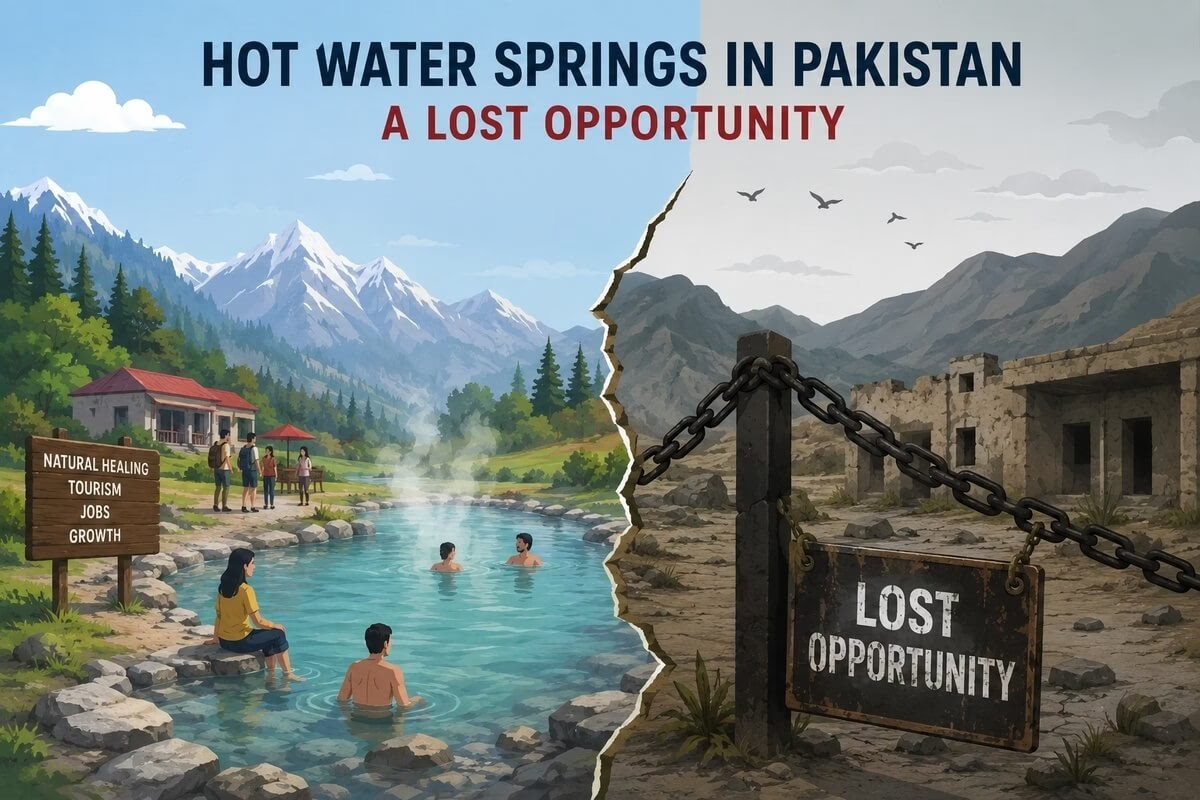
Over the years, I have visited three hot water springs in Pakistan. I know there are many.
The first was Tata Pani in Diamer District along the Karakoram highway (KKH).
I remember the hot water.
And, I also remember stopping there.
What I do not have is single photograph.
For someone who photographs trees, shadows, roads and practically anything that makes me pause, this says a lot. The place was visually unappealing that I forgot to take a picture.
Years later, I visited another Tatta Pani, this time near Kotli in Azad Kashmir.
.jpg)
This was different.
The hot water springs sat close to the river Poonch, surrounded by naturally beautiful landscape. There was something quite extraordinary about hot water emerging beside the river’s cold water. Unlike my first Tatta Pani, this was the place I wanted to look at. Recorded temperatures of Tatta Pani Springs in Kotli is around 59 to 61°C.
Nature has done her part.
Human beings, unfortunately, had been less inspired.
There was an old, rather run-down building where visitors could apparently take a bath. Perhaps I am being fussy, but I looked at the bathing facility and immediately knew one thing.
I was never going to take a bath there.
And that is the problem.
My third hot spring was Garam Chasma in Chitral.
This I went with expectations.
After all, an entire town is called Garam Chasma- Hot spring.
The road through the Chitral landscape was beautiful. The name itself promised something elemental: mountains, cold air and water heated somewhere deep inside the earth.
But the walk up towards the spring was dirty.
And when I finally reached it, I found myself slightly confused.
Where was the spring?
.JPG)
What I encountered as a visitor was a cemented area with warm water. Not a dramatic natural pool. Not an inviting bathing facilities. Not even water hot enough, at least where I reached it, to boil an egg.
A 2015 Express tribune article described the visible volume of Garam Chasma as having reduced after water was diverted to bathing facilities. Another newspaper account even claimed the water had to be cooled before bathing. Standing there recently, however, I found it difficult to reconcile that description with the warm water I encountered.
Perhaps, then, the problem is not the spring.
The problem is what we have done – or failed to do – around it.
We have the Natural Resources. We have not created the Experience.
Around the world, hot springs are the destinations in themselves.
In Japan, the word onsen does not simply refer to hot water coming out of the earth. It also refers to the bathing facilities and traditional Inns developed around the springs.
Iceland has done something similar in its own way. Natural geothermal water is part of the country’s bathing culture, with facilities ranging from rustic local pools to sophisticated wellness retreats.
According to the Global Wellness Institute, more than 31,000 thermal and mineral spring establishments were operating worldwide in 2024, generating an estimated $72 billion in revenue. Governments and private investors in several countries are renovating old and primitive bathing facilities precisely because modern visitors expect better standards.
Meanwhile, we have hot water coming naturally out of mountains in some of Pakistan’s most spectacular landscapes.
And sometimes we put a cement room around it and consider the work finished.
I Am Not Asking for a Five Star Spa
This is important.
I do not want Garam Chasma turned into Dubai.
I don’t want marble floors, neon signs, loud music and a café selling Rs 1,500 cappuccinos beside the spring.
What I am asking for is much simpler.
A clean path to the spring.
Proper waste management.
A beautifully designed but locally appropriate bathing house.
Separate, private and dignified bathing areas for men and women.
A few private family bathing rooms.
Clean changing rooms.
Warm spaces where people can sit after bathing.
Clear information about the spring, its geology and water temperature.
Perhaps a small outdoor foot bath for visitors who do not want a full bath.
Local stones. Local wood. Chitrali craftsmanship.
And someone responsible for cleaning the place every day.
That is not luxury.
That is tourism infrastructure,
There is another Issue: Stop Calling Everything a Cure
There is also a scientific responsibility here.
Hot water springs all over Pakistan are surrounded by stories of miraculous cures for skin problems, joint pain and practically everything else.
Warm water may certainly be relaxing. Heat and buoyancy can affect comfort and the experience of pain. But folklore should not replace testing.
A 2022 study published in Chemosphere found radon-222 concentration limit above the US-EPA benchmark used by the researchers in all hot-spring water samples collected from Tata Pani in Gilgit and Garam Chasma in Chitral. The estimated annual exposure dose associated with water consumption was substantially higher in Tata Pani, where it exceeded the WHO threshold cited by the authors. The study concluded that the sampled hot-spring water should be avoided for drinking and domestic use.
That caught my attention.
People apparently stop at Tata Pani, bathe and even fill bottles with water to drink- a practice specifically noted by the researchers.
.JPG)
Imagine Garam Chasma Done Properly
I keep thinking about Garam Chasma.
An entire town carries the name of its hot spring.
That is branding most tourist destinations would spend millions trying to invent.
Imagine arriving after the long journey through Chitral.
You follow a clean stone path along the mountain.
There are small signs explaining why the earth beneath this part of the Hindu Kush produces thermal water.
You enter a simple building designed in the local architectural language.
Inside are warm, clean, private bathing areas.
Perhaps there is one outdoor thermal pool overlooking the mountains.
The number of visitors is controlled.
Local people run the facility.
Local women produce towels, soap or small craft items sold nearby.
A modest entrance fee pays for cleaning and maintenance.
Visitors stay for two hours instead of ten minutes.
Some stay overnight in the town.
They eat there.
They hire local drivers.
They buy something
They tell other people about the experience.
Suddenly a hot water outlet becomes a destination.
The frustrating thing is that Pakistan does not need to invent the attraction.
The attraction is already there.
The earth has already heated the water.
The mountains are already there.
The stories are already there.
We simply need to learn the final step: how to receive a visitor.
After three hot springs in Pakistan, my conclusion is not that our springs are disappointing.
My conclusion is almost the opposite.
They are waster possibilities.
And perhaps that is why I am still thinking about them
Discover new places, ideas and stories from How 2 Have Fun — delivered occasionally to your inbox.
Subscribe →